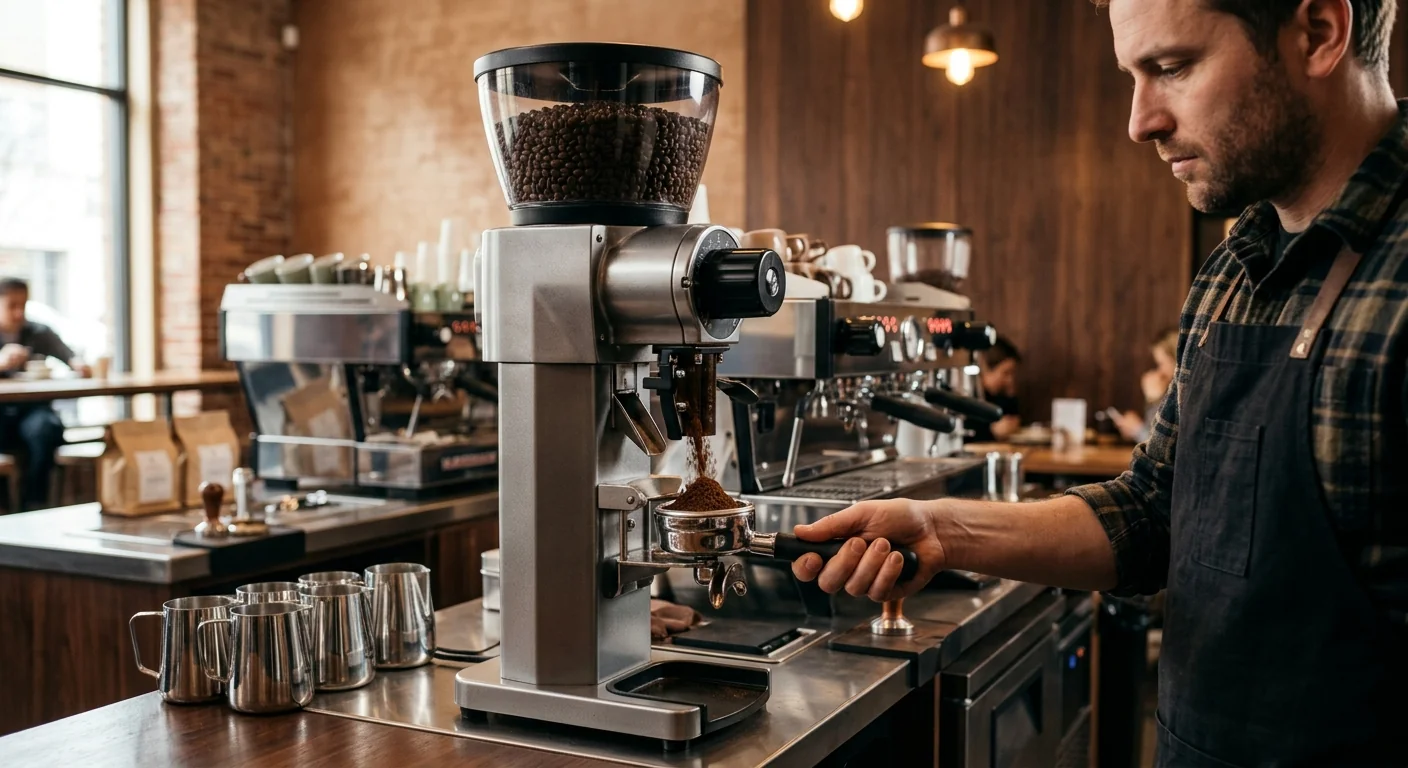
Most coffee guides bury the grinder. We put it first.
If you’ve spent time on our complete coffee equipment guide, you already know that gear choices compound. But no single upgrade changes what’s in your cup more dramatically than switching to the right best coffee grinder for your brew method. Here’s why — and exactly which grinder to buy.
Do I Really Need a Burr Grinder?
Yes. The evidence is direct and the reason is physics.
According to Serious Eats, blade grinders use spinning blades that chop beans into irregular pieces — producing a chaotic mix of ultra-fine dust, salt-sized fragments, sand-sized chunks, and large pieces all in a single grind. That inconsistency isn’t just an aesthetic problem. Fine particles over-extract (producing bitterness) while large chunks under-extract (producing sourness) — simultaneously, in the same brew.
A burr grinder, by contrast, uses two revolving abrasive surfaces set at a precise distance apart. Every bean passes through the same gap. Every particle comes out roughly the same size. The result is a cup that tastes like the coffee is supposed to taste.
According to Breville, burr grinders also crush beans at their natural breaking point rather than cutting them — preserving cellular structure and keeping more aromatic compounds soluble. That’s the difference between a flat, muddled cup and one with clarity and depth.
Blade vs. Burr: What the Grind Actually Looks Like
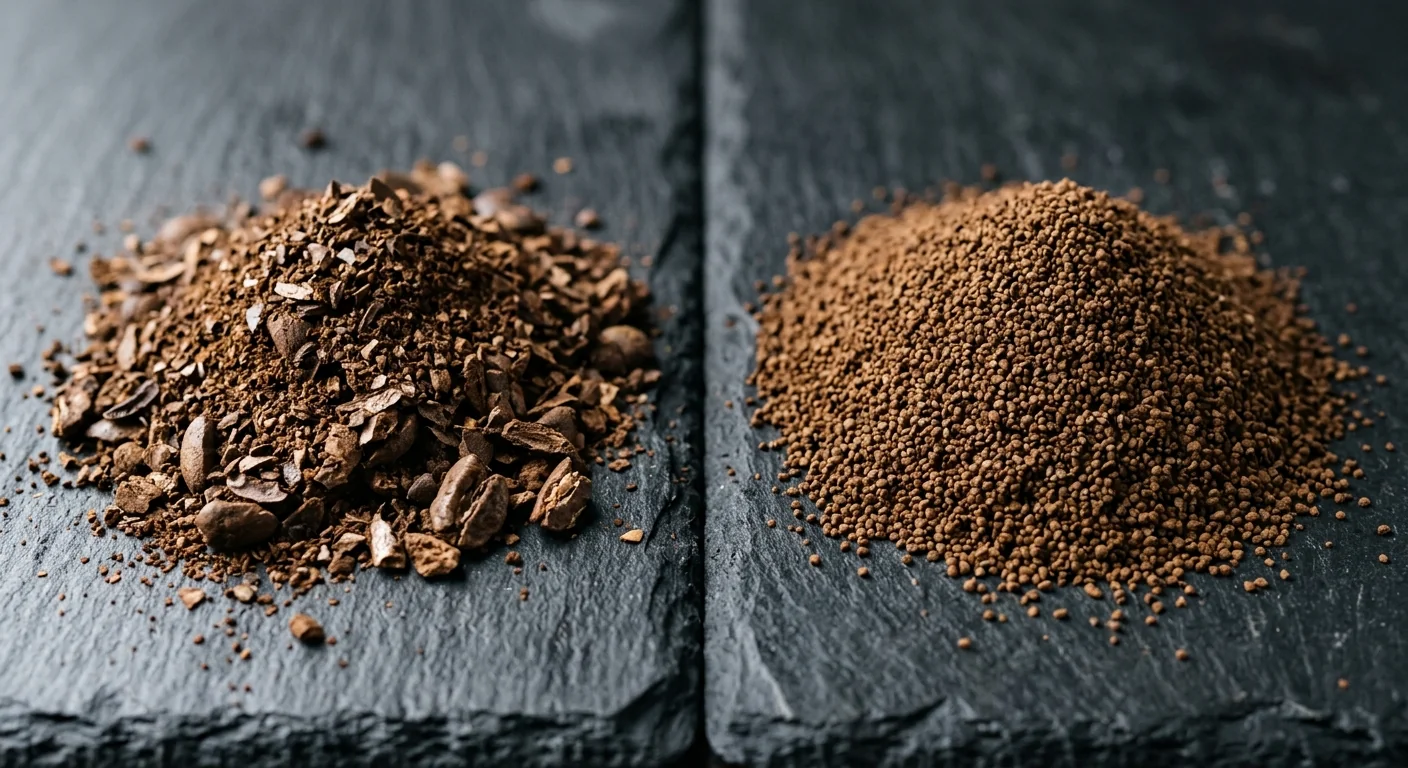
The visual difference is stark. Blade-ground coffee looks like a pile of rubble — dust mixed with pebbles. Burr-ground coffee looks like fine, uniform sand. That uniformity is what the Honest Coffee Guide’s grind size chart is built around: blade grinders aren’t even included, because they don’t produce a consistent, measurable grind size.
The Specialty Coffee Association (SCA) has formalized this standard: for cupping, grind particle size should have 70%–75% of particles passing through a U.S. Standard size 20 mesh sieve (approximately 850 microns). That level of precision is only achievable with a burr grinder.
Conical Burr vs. Flat Burr: Which Is Better?
There are two main burr configurations, and the difference matters as you move up in budget.
- Conical burr grinder: A cone-shaped burr rotates inside a stationary ring burr. Easier to calibrate, less expensive to manufacture, and the dominant design in home grinders. Most grinders under $300 use conical burrs.
- Flat burr: Two horizontally-mounted disc burrs face each other. Harder to align correctly, but according to Serious Eats, flat burrs tend to produce better flavor clarity and slightly more consistent particle size in high-end models.
For most home brewers, a quality conical burr grinder is the right call. Flat burr advantages become meaningful at the $400+ tier.
Grinder Comparison Table: 8 Top Picks by Budget
The Grind Consistency column below reflects particle size uniformity — the single most important factor in cup quality. Higher consistency means fewer bitter fines and fewer under-extracted chunks in the same brew.
| Grinder | Price | Type | Grind Settings | Best For | Noise Level | Grind Consistency | Value Rating |
|---|---|---|---|---|---|---|---|
| Generic Blade Grinder | ~$20 | Blade | None (pulse only) | Emergency use only | Low | ★☆☆☆☆ (irregular dust + chunks) | ★★☆☆☆ |
| OXO Conical Burr Grinder | $100 | Conical Burr | 15 settings | Drip, French press | Medium | ★★★☆☆ (uniform at coarse settings) | ★★★★☆ |
| 1Zpresso J Manual Grinder | $139 | Conical Burr (manual) | 90+ clicks | Pour-over, travel | Silent | ★★★★☆ (tight particle band) | ★★★★★ |
| Baratza Encore ESP | $200 | Conical Burr | 40 settings | Drip + light espresso | Medium | ★★★★☆ (consistent across range) | ★★★★☆ |
| Baratza Virtuoso+ | $250 | Conical Burr | 40 settings | Drip, pour-over | Medium | ★★★★☆ (consistent across range) | ★★★★★ |
| Baratza Sette 270 | $400 | Conical Burr | 270 settings | Espresso | Medium-High | ★★★★★ (micro-precise for espresso) | ★★★★☆ |
| Fellow Ode Gen 2 | $365 | Flat Burr | 31 settings | Pour-over, filter | Medium | ★★★★★ (flat burr clarity) | ★★★★☆ |
| Niche Zero | $700 | Conical Burr | 63 settings | Espresso + filter | Low | ★★★★★ (single-dose precision) | ★★★★☆ |
Recommendations for the OXO, 1Zpresso J, Baratza Encore ESP, Baratza Virtuoso+, and Baratza Sette 270 are based on Serious Eats’ testing of 19 coffee grinders. The Fellow Ode Gen 2 and Niche Zero are referenced in Serious Eats’ enthusiast-tier coverage.
Budget Tiers: Which Grinder Is Right for You?
Under $50: Blade Grinders and Entry Burr
Blade grinders in this range are better than no grinder — but only marginally. If you’re brewing drip coffee with pre-ground beans and want to switch to whole bean, a blade grinder is a temporary step, not a destination. The grind inconsistency described above will limit your cup quality regardless of how good your coffee maker is.
At the very top of this tier, some entry-level burr grinders appear. Treat them as a bridge, not a solution.
$50–$150: Mid-Range Burr Grinders
This is where real coffee brewing begins. The OXO Conical Burr Grinder at $100 is the standout value — according to Serious Eats, it’s the best budget pick after testing 19 grinders. It handles drip and French press well with 15 grind settings and consistent output.
$150–$300: The Baratza Sweet Spot
The Baratza Encore ESP ($200) and Baratza Virtuoso+ ($250) sit in the most competitive tier for home brewers. Serious Eats names the Virtuoso+ as best overall burr grinder. Its burrs are rated for 500 pounds of coffee — roughly 8–10 years of use at one pound per week. That’s a long-term investment that pays off quickly compared to replacing cheap grinders every two years.
Total cost of ownership perspective: A $25 blade grinder replaced every two years costs $125 over a decade — and delivers poor grind consistency throughout. The Virtuoso+ at $250, used for 8–10 years, works out to roughly $25–$30 per year with consistently uniform particle size the entire time. The math favors the burr grinder from year one.
The Encore ESP adds espresso-capable fine grind settings at a lower price point, making it an excellent pairing for a home espresso machine.
$300+: Enthusiast Territory (Best Burr Grinder Performance)
The Baratza Sette 270 ($400) is Serious Eats’ pick for best espresso grinder, with 270 micro-adjustment settings designed specifically for dialing in espresso. At this tier, you’re also looking at the Fellow Ode Gen 2 ($365) — a flat burr grinder optimized for pour-over and filter coffee — and the Niche Zero ($700), which targets single-dose workflows with conical burr precision and unusually low grind retention.
Best Espresso Grinder: What Espresso Actually Demands
Espresso demands the finest, most consistent grind of any brew method. According to the Honest Coffee Guide, espresso requires a particle size of just 180–380 microns — a range that requires precise, repeatable micro-adjustments that blade grinders and most entry burr grinders simply cannot deliver.
For espresso, the minimum recommendation is the Baratza Encore ESP ($200). If your espresso machine costs $500 or more, the Baratza Sette 270 is the more appropriate pairing — its 270 grind settings give you the precision to dial in extraction shot by shot.
Rule of thumb: Spend at least 25–30% of your espresso machine budget on the grinder. A $500 machine with a $20 blade grinder will never reach its potential.
Manual vs. Electric Coffee Grinder
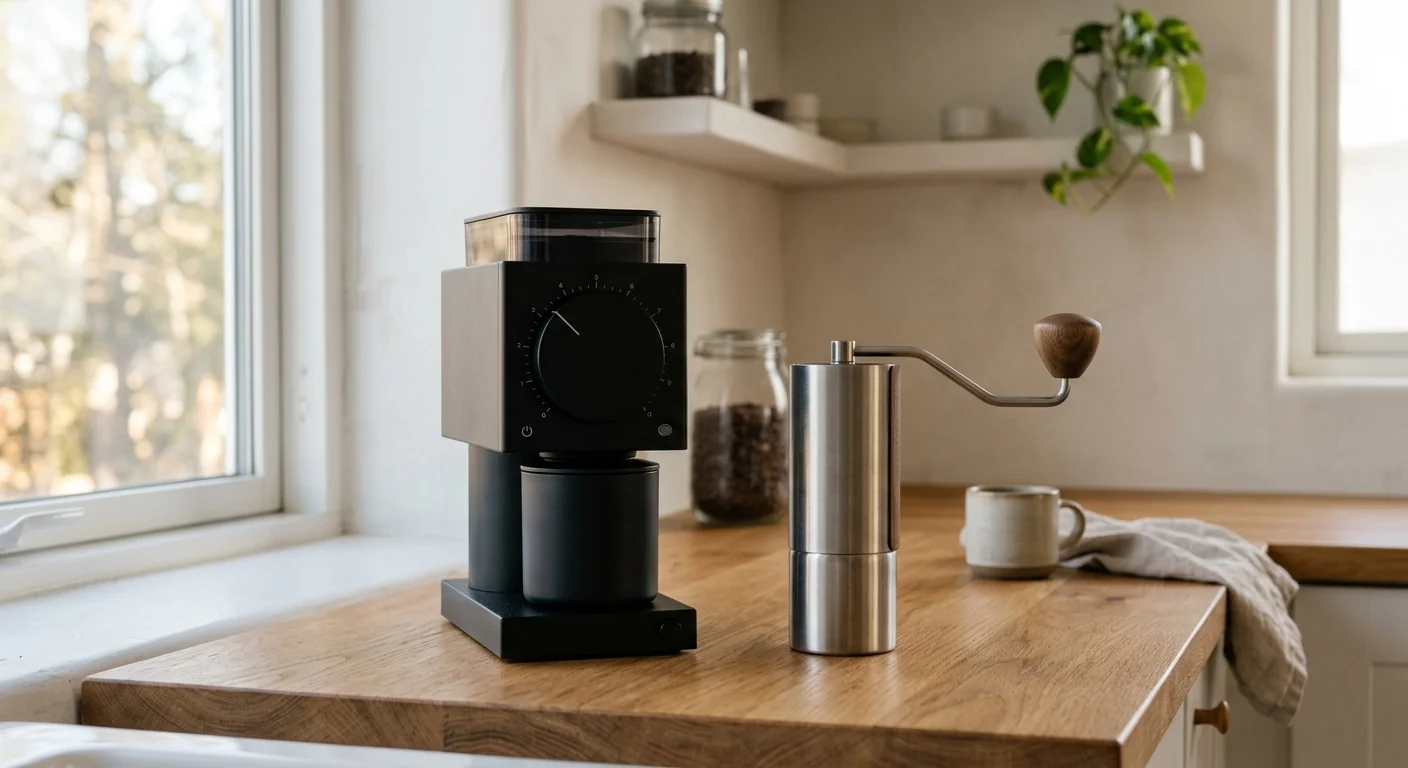
The manual coffee grinder is underrated. For travelers, campers, or anyone on a tight budget who wants genuine burr-ground coffee, a quality hand grinder outperforms electric grinders at the same price point — because the manufacturing cost goes into the burrs rather than a motor.
The 1Zpresso J Manual Grinder ($139) is Serious Eats’ pick for best handheld grinder. It’s silent, portable, and produces grind quality that rivals electric grinders twice its price. The trade-off is time: grinding 18–20 grams for a pour-over takes about 60–90 seconds of hand cranking.
Choose manual if: You travel frequently, have a small kitchen, prioritize silence (apartments, early mornings), or want maximum grind quality per dollar spent.
Choose electric if: You brew multiple cups daily, value convenience, or are grinding for espresso (where consistent torque matters for fine grinding).
Best Coffee Grinder for Your Brewing Method
Different brew methods require dramatically different grind sizes. According to the Honest Coffee Guide’s grind size chart, the ranges span from 40 microns (Turkish coffee) to 1,400 microns (cold brew). Here’s the practical matching matrix:
| Brew Method | Grind Size | Micron Range | Minimum Grinder Tier |
|---|---|---|---|
| Espresso | Extra fine | 180–380 µm | Mid burr ($150+) |
| Moka pot | Fine-medium | 360–660 µm | Entry burr ($100+) |
| Pour-over / V60 | Medium-fine | 400–700 µm | Entry burr ($100+) |
| Drip coffee maker | Medium | 410–930 µm | Entry burr ($100+) |
| French press | Coarse | 690–1,300 µm | Any burr grinder |
| Cold brew | Extra coarse | 800–1,400 µm | Any burr grinder |
For a deeper look at how grind size interacts with each method, see our brewing methods guide. And if you’re shopping for a drip machine to pair with your new grinder, our best drip coffee makers guide covers the top options at every price point.
Espresso Machine with Grinder: Honest Pros and Cons
Combo units — an espresso machine with grinder built in — are tempting. One appliance, one footprint, one purchase. But there are real trade-offs worth understanding before you buy.
Pros of combo units:
- Streamlined workflow (grind and brew in one step)
- Smaller counter footprint
- Often cheaper than buying two separate quality units
Cons of combo units:
- If the grinder fails, the whole machine is compromised
- Grinder quality in combos typically lags behind standalone grinders at the same total price
- You can’t upgrade one component independently
- Grind adjustments are often less precise than dedicated grinders
For casual home brewers who want simplicity, a quality combo unit is a reasonable choice. For anyone serious about espresso quality, a standalone espresso grinder paired with a dedicated machine will outperform a combo at the same price point. The Baratza Encore ESP + a mid-range espresso machine is a more capable setup than most combo units under $600.
Frequently Asked Questions
Is a burr grinder worth it?
Yes — for almost every brewer. The flavor difference between blade-ground and burr-ground coffee is not subtle. According to Serious Eats, blade grinders produce a mix of particle sizes that simultaneously over-extract and under-extract in the same brew, creating a cup that’s both bitter and sour. A $100 burr grinder eliminates that problem entirely. The OXO Conical Burr Grinder at $100 is a reasonable entry point that will outperform any blade grinder and most $200 coffee makers.
What grinder should I buy for a $500 espresso machine?
Spend $150–$200 minimum on the grinder. The Baratza Encore ESP ($200) is the right pairing — it’s specifically designed with espresso-capable fine grind settings and has 40 grind adjustments for dialing in your shot. If your espresso machine is at the higher end of $500, consider stretching to the Baratza Virtuoso+ ($250) for its superior build quality and burr longevity. Pairing a $500 machine with anything less than a quality burr coffee grinder means you’re leaving most of that machine’s capability on the table. See our espresso machine guide for compatible machine recommendations at every budget.
What is the best burr grinder for beginners?
The OXO Conical Burr Grinder ($100) is the most accessible entry point. It offers 15 grind settings, handles drip and French press reliably, and produces consistent particle size that a blade grinder cannot match. According to Serious Eats’ testing of 19 grinders, it’s the top budget pick. If you’re brewing pour-over or want more grind range, the Baratza Encore ESP ($200) is the next step up and covers everything from drip to light espresso.
How often do burr grinder burrs need to be replaced?
Burr lifespan depends on the grinder and usage. According to Serious Eats, the Baratza Virtuoso+‘s burrs are rated for 500 pounds of coffee — approximately 8–10 years at one pound per week. Most quality burr grinders in the $150–$300 range are designed for similar longevity. Signs that burrs need replacing include noticeably inconsistent grind output, increased fines, or a dull grinding sound. Baratza in particular is known for its parts availability and repairability, which extends the practical lifespan of its grinders further.
Is a manual coffee grinder as good as an electric one?
At the same price point, a quality manual grinder often outperforms an electric one — because the manufacturing cost goes into the burrs rather than a motor. The 1Zpresso J Manual Grinder ($139) is Serious Eats’ pick for best handheld grinder and produces grind quality that rivals electric grinders at twice the price. The practical trade-off is time and effort: grinding enough coffee for a pour-over takes 60–90 seconds of hand cranking. For daily multi-cup brewing or espresso (where consistent motor torque helps with fine grinding), an electric grinder is the more practical choice.
Does grind size really affect taste that much?
Yes — grind size is one of the two primary variables in extraction, alongside water temperature. According to the Honest Coffee Guide, espresso requires particles in the 180–380 micron range while French press uses 690–1,300 microns — a difference of nearly 10x. Brewing espresso with a coarse grind produces weak, sour, under-extracted coffee. Brewing French press with a fine grind produces muddy, over-extracted sludge. The SCA’s cupping standard — 70–75% of particles passing through a U.S. Standard size 20 mesh sieve — exists precisely because grind consistency is that consequential to flavor.