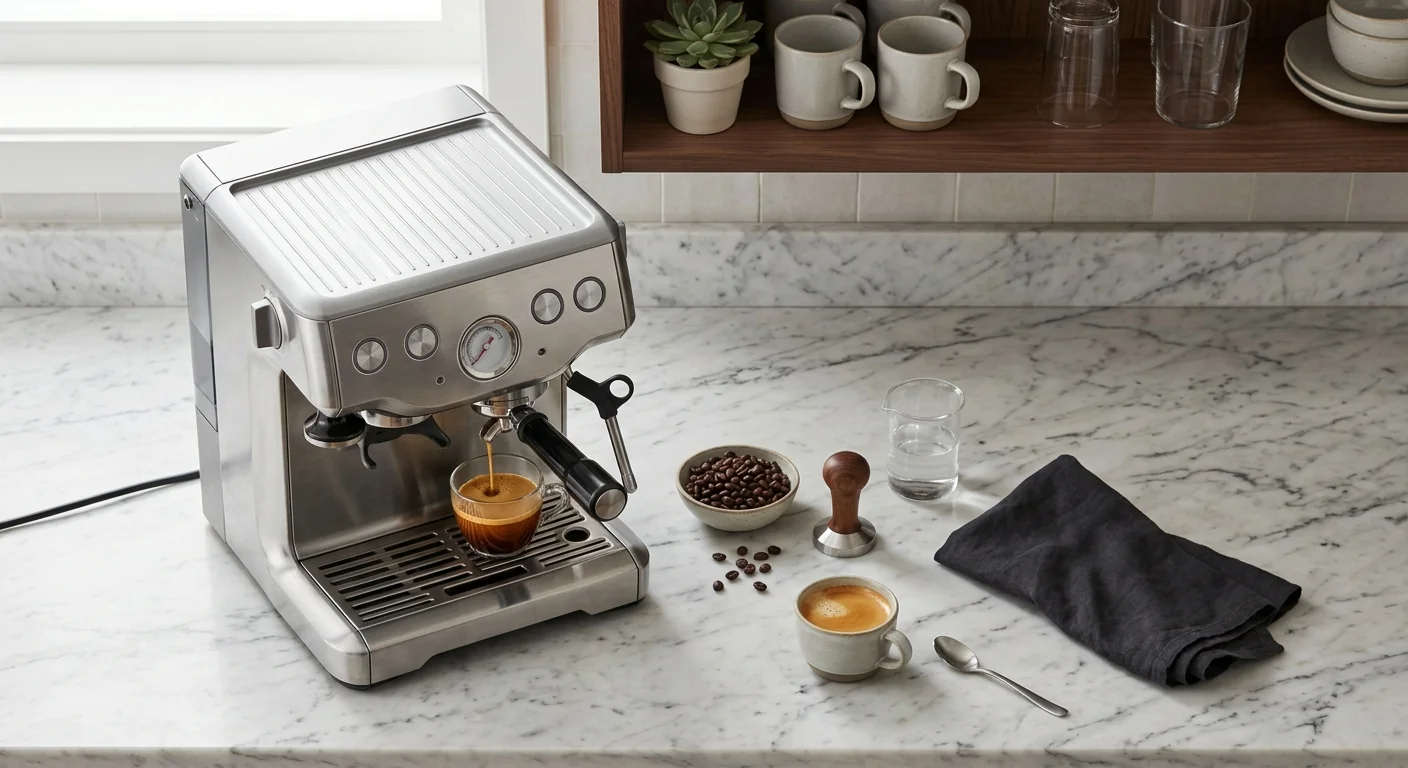
Which Espresso Machine Is Actually Worth It?
Finding the best espresso machine means looking beyond price tags. The hardest part of buying the best espresso machine isn’t choosing between brands — it’s figuring out what you’re actually getting for your money when comparing semi-automatic, automatic, and capsule espresso machines. A $150 machine and a $500 machine both claim to make espresso. Only one of them reliably does.
According to CoffeeGeek, achieving quality home espresso in 2025 requires a starting budget of roughly $500 — covering both a capable machine and a good burr grinder. Entry-level pump machines that used to fill the $150–$250 gap have largely vanished due to inflation, pushing the realistic floor for a machine-only purchase to around $300.
This guide breaks down the best espresso machine options by budget tier, with honest total cost of ownership figures and a machine-type explainer — so you can buy once and brew well.
Quick Comparison: Top Espresso Machines at a Glance
| Machine | Price | Type | Ease of Use | Steam Wand | Grinder Included | Reliability |
|---|---|---|---|---|---|---|
| De’Longhi Stilosa | ~$100–$150 | Semi-auto | ★★★★☆ | Manual | No | ★★★☆☆ |
| De’Longhi Dedica | ~$200–$250 | Semi-auto | ★★★★☆ | Manual | No | ★★★★☆ |
| Nespresso Vertuo | ~$150–$250 | Capsule/Auto | ★★★★★ | No (separate) | No (capsules) | ★★★★☆ |
| Ninja Luxe Cafe | ~$499 | Semi-auto | ★★★★☆ | Auto/Manual | Yes (built-in) | ★★★★☆ |
| Breville Barista Express | ~$550–$700 | Semi-auto | ★★★★☆ | Manual | Yes (built-in) | ★★★★★ |
| Breville Bambino Plus | ~$500 | Semi-auto | ★★★★★ | Auto/Manual | No | ★★★★★ |
| Gaggia Classic Pro | ~$499–$549 | Semi-auto | ★★★☆☆ | Manual | No | ★★★★★ |
Reliability ratings reflect community consensus from sources including Home-Barista forums, CoffeeGeek, and Serious Eats long-term testing.
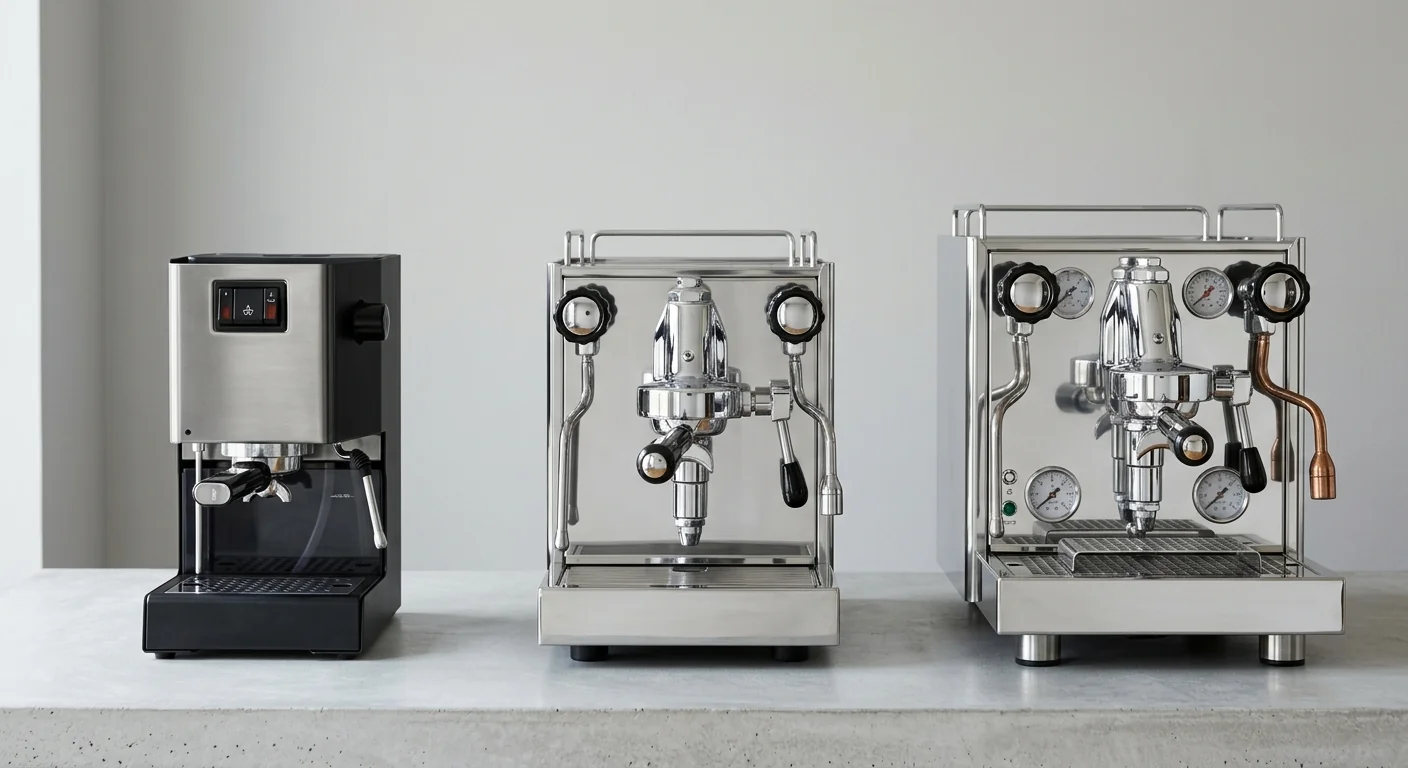
Machine Types Explained: Manual, Semi-Auto, and Fully Automatic
Before diving into budget tiers, it’s worth understanding what you’re actually operating. According to Serious Eats, proper espresso extraction requires 9 bars of pressure and water temperatures between 195°F and 205°F — and how much of that process you control depends on the machine type.
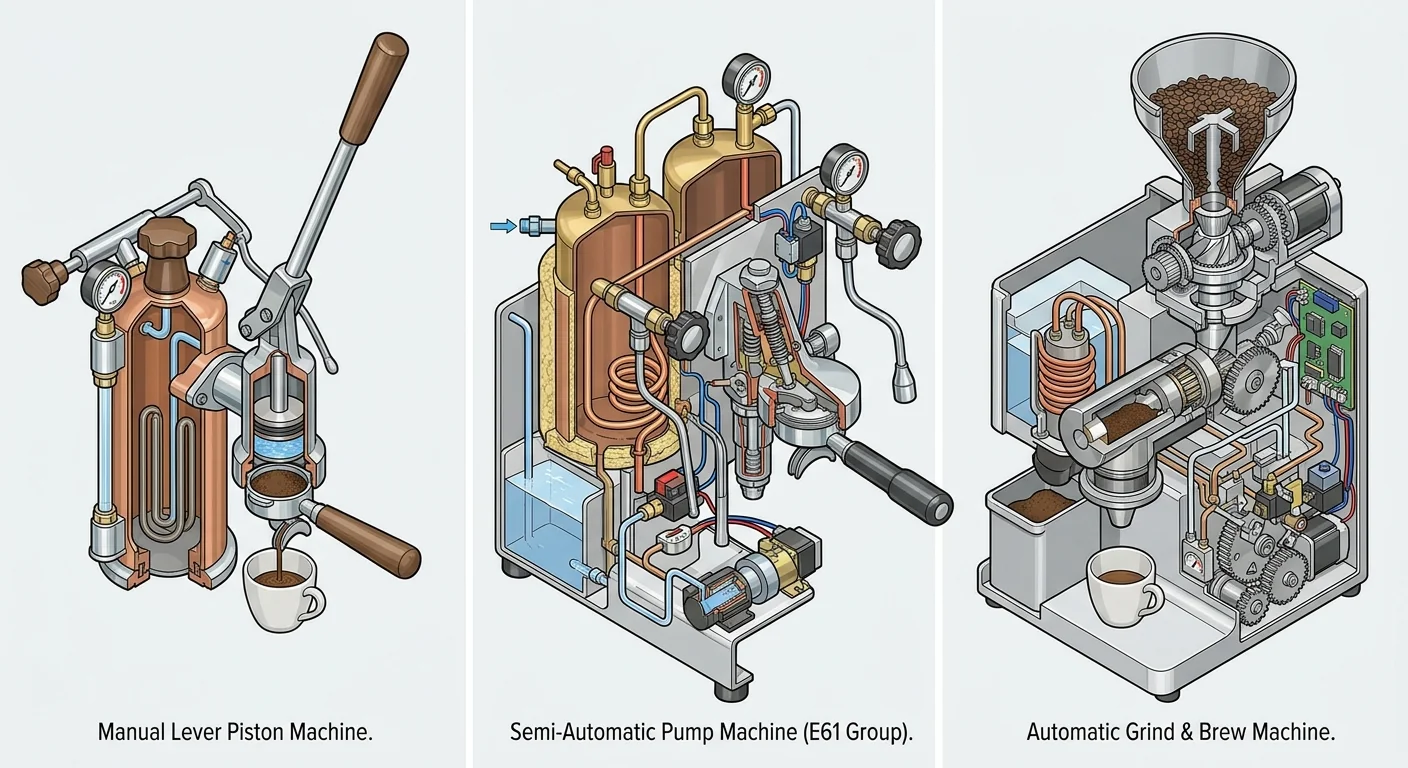
- Manual espresso machines give you full control over pressure and timing via a lever. Steep learning curve, exceptional ceiling for skilled users.
- Semi-automatic espresso machines automate the pump but require you to grind, dose, tamp, and time the shot. The most popular category for home baristas — balances control with convenience.
- Fully automatic (super-automatic) machines handle grinding, tamping, and shot pulling at the press of a button. Great for multi-person households, but sacrifice shot quality and are harder to repair.
For most buyers, a semi-automatic machine hits the sweet spot. The rest of this guide focuses there, with a note on capsule machines for beginners.
Budget Tier 1: Under $300
De’Longhi Stilosa (~$100–$150)
The De’Longhi Stilosa is the entry point Serious Eats recommends for beginners who want to try real espresso without a heavy financial commitment. It features a single-dial interface, a 54mm portafilter, a 1-liter water tank, a manual steam wand, and weighs just 8 pounds. The 1-year warranty is standard for this price range.
The trade-off: no PID temperature control, limited pressure consistency, and a steam wand that takes patience to use well. Think of it as a learning tool, not a forever machine.
Nespresso Vertuo (~$150–$250)
The Nespresso Vertuo is a capsule machine, not a traditional espresso machine — and that distinction matters. It produces a consistent, crema-topped coffee drink using proprietary pods, but the result isn’t espresso in the technical sense. There’s no steam wand included, and you’re locked into Nespresso’s capsule ecosystem.
For someone who wants a reliable morning ritual with zero technique required, it’s excellent. For someone who wants to develop barista skills, it’s a dead end. See our brewing methods guide for a deeper look at how capsule coffee compares to other extraction methods.
Total cost of ownership (Under $300 tier):
- Machine: $100–$250
- Separate burr grinder (required for Stilosa): $80–$150
- Accessories (tamper, scale, milk pitcher): ~$50
- Realistic starting total: $230–$450
Budget Tier 2: $300–$500
De’Longhi Dedica (~$200–$250)
The compact espresso machine category is where the De’Longhi Dedica shines. At roughly 6 inches wide, it fits on nearly any counter. It’s a solid semi-automatic machine for those who want espresso without sacrificing kitchen space. You’ll still need a separate grinder, and the panarello-style steam wand is easier to use but less precise for latte art.
Breville Barista Express (~$549–$700)
The best-selling espresso machine for over a decade, according to CoffeeGeek, the Breville Barista Express (BES870) is the machine most home baristas end up buying. Per Breville’s official specs, it includes:
- A 54mm stainless steel portafilter and integrated steel conical burr grinder with 16 precision grind settings
- Thermocoil heating with PID temperature control at 200°F
- A 15-bar Italian pump with low-pressure pre-infusion, then 9-bar extraction
- A 67 oz water tank, 1/2 lb bean hopper, and mechanical pressure gauge
The integrated grinder means you can go from beans to espresso in one workflow. It retails at $699.95 MSRP but is frequently found on sale at $549.95. The 1-year limited warranty is shorter than some competitors.
Do you also need a grinder? If you buy a machine without one (like the Bambino Plus, Gaggia Classic Pro, or De’Longhi Dedica), a quality burr grinder is non-negotiable for real espresso. Blade grinders produce uneven particle sizes that ruin extraction. See our best coffee grinders guide for top picks at every price point.
Total cost of ownership ($300–$500 tier):
- Machine (Barista Express): ~$550–$700
- Grinder: $0 (built-in) or $100–$200 (separate)
- Accessories: ~$50–$75
- Realistic starting total: $600–$775
Budget Tier 3: $500+ — For the Serious Home Barista
Breville Bambino Plus (~$500)
After testing 34 espresso machines, Serious Eats named the Breville Bambino Plus the best overall home espresso machine. Its ThermoJet heating system reaches brewing temperature in just 3 seconds, PID control locks in at exactly 200°F, and the automatic steam wand offers three temperature and foam density settings — making milk texturing genuinely approachable. It comes with a 2-year warranty and pre-infusion for even extraction. The catch: no built-in grinder, so budget an additional $100–$200.
Gaggia Classic Pro (~$499–$549)
The Gaggia Classic Pro is the machine the coffee community points to when someone asks about longevity. It uses commercial-grade internal parts, a 58mm portafilter (the same size as professional machines), a 2-liter water tank, and a steam wand powerful enough for genuine latte art. According to Serious Eats, it’s a legitimate enthusiast machine at a sub-$500 price point.
The notable limitation: no PID controller. Users need to “temperature surf” — flushing water through the group head to hit the right brewing temperature. Home-Barista forum users frequently cite the Gaggia Classic Pro as one of the most repairable machines in this price range, with many units running reliably for 10+ years.
Total cost of ownership ($500+ tier):
- Machine: $500–$700
- Separate burr grinder: $150–$300
- Accessories (tamper, scale, WDT tool, milk pitcher): $75–$150
- Realistic starting total: $725–$1,150
The Ninja Espresso Machine: Best for Versatility
The Ninja Luxe Cafe (MSRP $499) is a strong contender for buyers who want flexibility without multiple appliances. Introduced in August 2024, it’s CoffeeGeek’s top pick for versatile budget espresso in 2025. Key features:
- Built-in 25-setting grinder with integrated dosing scale
- PID-controlled brewing with instant heat
- Automated and manual frothing, including ice-cold foam
- Cold brew modes and a 3-way solenoid valve
The ninja espresso machine competes directly with the Breville Barista Express on price and built-in grinder convenience, while adding cold brew and iced drink modes. It’s a newer machine with less long-term reliability data, but early community reception has been positive.
Nespresso vs. Traditional Espresso: Which Is Right for Beginners?
Choose Nespresso if:
- You want consistent results with zero technique
- Counter space and simplicity are top priorities
- You don’t want to buy or maintain a grinder
Choose a traditional semi-automatic if:
- You want to develop real barista skills
- You care about shot quality and customization
- You plan to make milk-based drinks with real steamed milk
The home espresso community on forums like Home-Barista is consistent on this point: Nespresso produces a convenient beverage, but it isn’t espresso in the traditional sense. If the craft matters to you, a semi-automatic machine is the right path.
Reliability and Real-World Longevity
- Breville machines (Bambino Plus, Barista Express) are praised for build quality, with most users reporting 5–8 years of reliable service. The 1-year warranty on the Barista Express is a common complaint.
- Gaggia Classic Pro is widely regarded as one of the most repairable machines under $600. Its commercial-grade internals and simple design mean parts are available and repairs are DIY-friendly.
- De’Longhi machines (Stilosa, Dedica) are reliable for their price tier, though they use more plastic internals than Breville or Gaggia at comparable price points.
- Ninja Luxe Cafe is too new for long-term reliability data, but early reports are positive.
The most reliable machines tend to share two traits: simple internal designs and widely available replacement parts.
Frequently Asked Questions
Is a $200 espresso machine worth it?
It depends on your expectations. The De’Longhi Stilosa at $100–$150 is a legitimate entry point for beginners, according to Serious Eats — but it lacks PID temperature control and produces inconsistent pressure compared to machines in the $400–$600 range. A $200 machine can teach you the basics of espresso preparation, but you’ll likely outgrow it within a year if you develop any interest in shot quality. If you can stretch to $300–$350, you’ll get meaningfully better results.
Do I need a burr grinder for espresso?
Yes — for any traditional semi-automatic espresso machine, a quality burr grinder is essential. Espresso requires a very fine, consistent grind that blade grinders cannot produce. According to CoffeeGeek, the $500 total budget for quality home espresso should account for both machine and grinder. The exceptions are machines with built-in grinders (Breville Barista Express, Ninja Luxe Cafe) and capsule machines (Nespresso). See our best coffee grinders guide for specific recommendations.
The Bottom Line
The best espresso machine for home use isn’t the most expensive one — it’s the one that matches your skill level, workflow, and realistic budget including a grinder. Here’s the short version:
- Just starting out, budget under $200: De’Longhi Stilosa + a basic burr grinder
- Best all-in-one value: Breville Barista Express or Ninja Luxe Cafe (~$550–$700 total)
- Best overall machine (separate grinder required): Breville Bambino Plus
- Best for longevity and enthusiasts: Gaggia Classic Pro + a quality grinder
- Best for zero-effort espresso drinks: Nespresso Vertuo
Explore our full home coffee setup guide for recommendations on accessories, beans, and everything else you need to build a setup you’ll actually use every day.