The drip coffee maker aisle is a wall of nearly identical black plastic boxes with wildly different price tags. Picking the best drip coffee maker without a guide is genuinely confusing, and a bad choice means years of mediocre mornings. This page cuts through the noise: honest picks by budget tier, a plain-English breakdown of what actually matters, and the data to back it up.
New to home coffee? The Coffee Starter Hub is a good companion to this guide.
Master Comparison Table
The table below covers eight machines across all budget tiers. Reliability scores are drawn from independent lab testing by TechGearLab (11-machine test cohort). SCA certification indicates the machine meets the Specialty Coffee Association’s Certified Home Brewer standards for water temperature (195°F–205°F) and brew quality.
| Machine | Price | Carafe | Capacity | Avg Brew Temp | Programmable | SCA Certified |
|---|---|---|---|---|---|---|
| Technivorm Moccamaster KBT | ~$339 | Thermal | 10-cup | 193°F | No | ✅ |
| Breville Precision Brewer | ~$330 | Thermal | 12-cup | 195.6°F | Yes | ✅ |
| OXO Brew 9-Cup | ~$200 | Thermal | 9-cup | ~200°F | Yes | ✅ |
| Cuisinart 14-Cup Programmable | ~$100 | Glass | 14-cup | ~195°F | Yes | ❌ |
| Ninja 12-Cup Programmable CE251 | ~$90 | Glass | 12-cup | 202.5°F | Yes | ❌ |
| Black+Decker 12-Cup Thermal | ~$78 | Thermal | 12-cup | 177.4°F | No | ❌ |
| Bunn Speed Brew Classic | ~$80 | Glass | 10-cup | ~200°F | No | ❌ |
| Black+Decker 12-Cup Easy On/Off | ~$30 | Glass | 12-cup | 169.9°F | No | ❌ |
A note on brew temperature: According to the Specialty Coffee Association, the optimal extraction range is 195°F–205°F. Machines that fall below this consistently — like the Black+Decker Easy On/Off at an average of 169.9°F — produce noticeably lighter, less complex coffee due to under-extraction, per TechGearLab’s lab testing.
Budget Tier Breakdown
Under $50 — Entry-Level
Best pick: Black+Decker 12-Cup Easy On/Off (~$30)
At this price, expectations should be calibrated honestly. The Black+Decker Easy On/Off gets coffee into a cup with minimal fuss, but TechGearLab’s testing found its average brew temperature of 169.9°F falls well below the SCA’s 195°F–205°F Golden Cup standard. The result is noticeably under-extracted coffee — lighter body, less complexity.
Entry-level machines are fine for households where coffee is purely functional and freshness isn’t a priority.
Under $50, you give up consistent brew temperature, programmable auto-brew, thermal carafe options, and any form of pre-infusion. If taste matters even a little, stretching to the $78–$100 range pays dividends.
$50–$150 — Mid-Range Best Values
This tier is where most buyers should land. You get programmable features, better thermal performance, and in some cases a thermal carafe — without paying enthusiast prices.
Best overall value: Ninja 12-Cup Programmable CE251 (~$90)
According to TechGearLab, the Ninja CE251 is the top-rated budget drip coffee maker in their 11-machine test, hitting an average max brew temperature of 202.5°F — well within SCA’s Golden Cup range. It includes programmable auto-brew, a removable water reservoir for easy filling, and pre-infusion (a short bloom phase that improves extraction). Brew time for a 6-cup pot is about 7 minutes 48 seconds, which is average for the class.
Best for large households: Cuisinart 14-Cup Programmable (~$100)
The Cuisinart 14-Cup handles big batches and includes programmable auto-brew. TechGearLab notes it has a bulky footprint and a somewhat confusing interface, but for families or offices that need volume, it’s a practical choice at $100.
Thermal carafe on a budget: Black+Decker 12-Cup Thermal (~$78)
The Black+Decker Thermal is notable for including an insulated carafe at a price point where most competitors use glass. The trade-off: TechGearLab measured its average brew temperature at 177.4°F, below the SCA’s optimal range, which affects flavor complexity. It’s a reasonable pick if keeping coffee warm without a hot plate matters more than peak extraction quality.
$150–$300 — Enthusiast-Grade
Best all-rounder: Breville Precision Brewer (~$330)
The Breville Precision Brewer earns the highest brew quality score in TechGearLab’s lineup — 9.4/10 — and is SCA certified. Its average brew temperature of 195.6°F sits right at the lower edge of the Golden Cup range, and it offers adjustable bloom time, temperature control, flow rate settings, and a cold brew mode. TechGearLab also rates it 8.8/10 for ease of use, the highest among high-end machines. For buyers who want serious coffee without a learning curve, this is the pick.
Best speed + craft: Technivorm Moccamaster KBT (~$339)
In TechGearLab’s independent lab test of 11 machines, the Moccamaster KBT ranked #1 overall with a score of 85/100. It brewed a 6-cup pot in just 4 minutes 18 seconds — the fastest of all machines tested — and is SCA certified. Its cone filter basket extracts floral, fruity, and nutty notes, per TechGearLab’s tasting panel. No programmable timer is a genuine trade-off, but build quality and longevity are well-documented.
Mid-tier enthusiast: OXO Brew 9-Cup (~$200)
The OXO Brew 9-Cup is SCA certified and hits the sweet spot between the Ninja’s value and the Breville’s premium features — certified brew quality without spending $330+.
Ninja Coffee Maker Lineup
Ninja has become one of the most searched auto drip coffee maker brands, and for good reason — their machines consistently hit high brew temperatures at accessible prices.
What Ninja does well:
- The CE251 hits 202.5°F average max brew temp, per TechGearLab — above many pricier competitors
- Pre-infusion (bloom) is included even on budget models
- Removable water reservoirs make daily filling easier than fixed tanks
- Programmable 24-hour auto-brew is standard across most models
Common complaints to know before buying:
Drip stop leaks: The drip stop mechanism — which lets you pull the carafe mid-brew — is a frequent complaint. The seal can degrade over time, leading to drips on the hot plate.
Carafe quality: Glass carafes on Ninja’s base models are functional but not particularly robust. If carafe durability is a concern, look at Ninja’s thermal carafe variants or consider the Breville.
Hot plate heat retention: TechGearLab found the Ninja CE251’s hot plate allows coffee to drop approximately 10°F over an hour. For those who want coffee hot two hours later, a thermal carafe model is the better call.
Cuisinart Coffee Maker Buyer’s Guide
Cuisinart is a reliable mid-range brand with a wide lineup. The 14-Cup Programmable at $100 is their most commonly recommended drip model — it handles large batches, offers programmable auto-brew, and has a solid track record.
Where Cuisinart excels:
- Large 14-cup capacity suits families and entertaining
- Programmable features standard across the lineup
- Widely available replacement carafes and filters
- Descaling takes about 30 minutes, per TechGearLab — reasonable for the class
Where to be cautious:
- TechGearLab notes the interface is more confusing than competing models at the same price
- The footprint is bulky — measure your counter space first
- Standard Cuisinart drip models don’t carry SCA certification
For SCA-level brew quality in this family of brands, the Café Specialty Drip Coffee is certified and worth the premium.
Bunn Coffee Maker: For Speed-Focused Buyers
Bunn built its reputation in commercial settings, and their home machines carry that DNA. The Bunn Speed Brew Classic (~$80) uses a hot water tank that stays pre-heated, meaning it can brew a full 10-cup pot in under 4 minutes — comparable to the Moccamaster’s speed at a fraction of the price.
The trade-off: The tank stays hot continuously, drawing power even when idle. For households that brew multiple pots daily, this is an efficiency win. For occasional brewers, the always-on draw is a real cost.
Bunn machines are notably durable — commercial heritage means parts are widely available and build quality outlasts most consumer-grade machines. The design is utilitarian and there’s no programmable timer, but for pure speed and reliability, Bunn is a legitimate choice.
Carafe Type Matters: Glass vs. Thermal
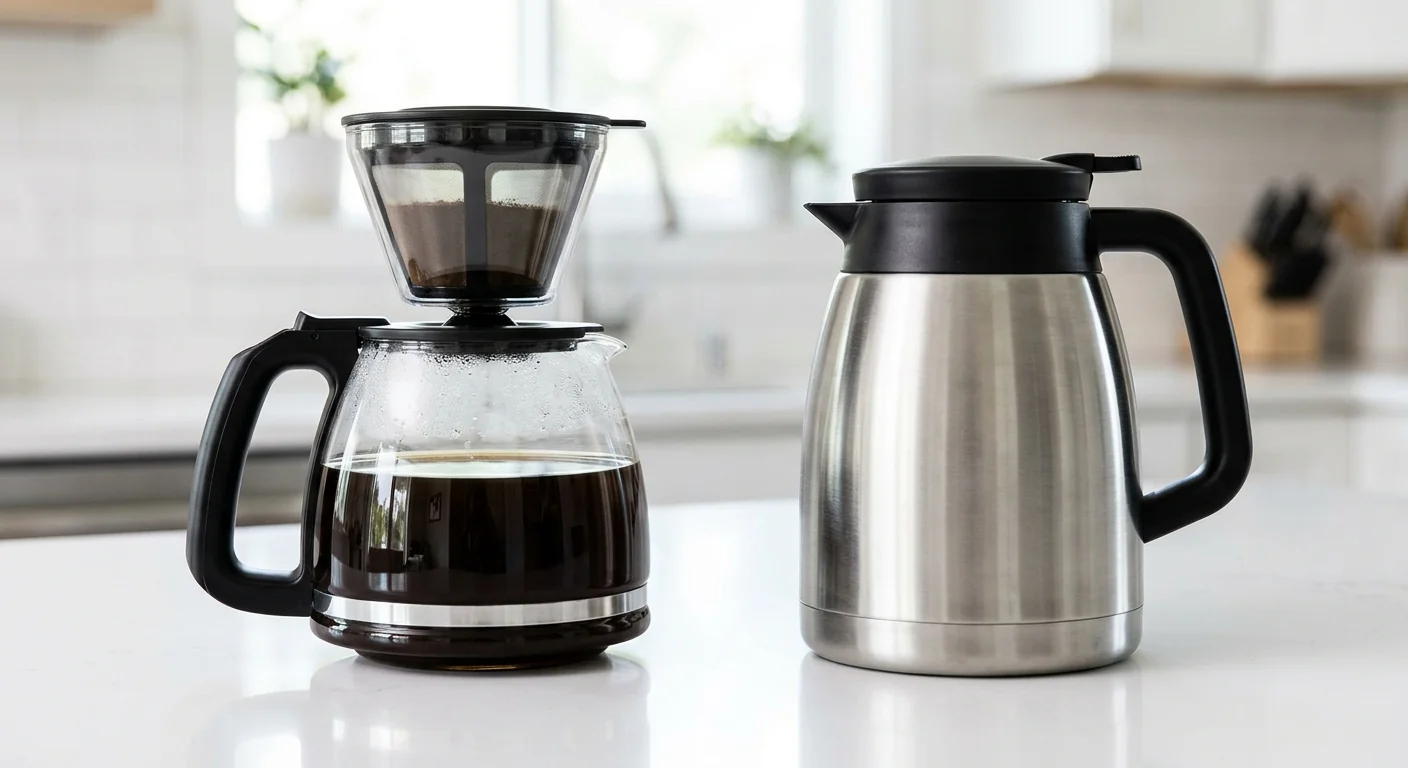
This is one of the most practical decisions in buying a drip coffee maker, and it’s often overlooked.
Glass carafes:
- Let you see exactly how much coffee remains
- Keep coffee warm via a hot plate
- Hot plates can negatively impact flavor if they run too hot or too cool, per TechGearLab
- Generally cheaper to replace when broken
- Coffee quality degrades faster — typically 20–30 minutes before flavor turns
Thermal carafes:
- Keep coffee warm for 2–4 hours without any heat source
- Preserve flavor better over time — no hot plate scorching
- Usually more expensive to replace
- You can’t see remaining volume without opening the lid
- Available even at modest price points — the Black+Decker 12-Cup Thermal at $78 is a notable example, per TechGearLab
The bottom line: If you drink your coffee within 20 minutes of brewing, glass is fine. If you brew a pot and come back to it throughout the morning, thermal is worth the premium.
Don’t Forget Your Grinder
Grinder callout: The single biggest upgrade you can make to drip coffee quality isn’t the machine — it’s grinding fresh. Pre-ground coffee loses volatile aromatics within days of opening. A burr grinder paired with any of the machines above will produce noticeably better results than the best coffee maker with pre-ground beans. See our full breakdown of the best coffee grinders to find a match for your budget.
A coffee maker with grinder combo can simplify the setup, but integrated grinders are typically blade-style or low-quality burr — fine for convenience, not for maximizing flavor.
Is a Drip Machine Right for You?
Drip coffee makers are the right tool for most households: they’re hands-off, brew large volumes, and fit any schedule with programmable timers. But they’re not the right tool for everyone.
A drip machine is a great fit if you:
- Brew 4+ cups at a time regularly
- Want coffee ready when you wake up (programmable auto-brew)
- Prefer a low-effort, consistent daily routine
Consider alternatives if you:
- Primarily brew 1–2 cups at a time — a pour-over or AeroPress is faster and cheaper
- Want espresso-based drinks like lattes or cappuccinos — see our best espresso machines guide
- Enjoy the ritual of manual brewing as part of your morning
For a full comparison of brewing methods — including French press, pour-over, AeroPress, and more — the brewing methods guide covers each format with honest trade-offs.
Total Cost of Ownership
The sticker price is only part of the story. Here’s what ongoing costs look like across machine tiers:
| Cost Item | Budget (~$30–$50) | Mid-Range (~$78–$100) | Enthusiast (~$200–$340) |
|---|---|---|---|
| Paper filters (annual) | ~$10–$15 | ~$10–$15 | ~$10–$15 (or $0 with reusable) |
| Descaling solution (annual) | ~$8–$10 | ~$8–$10 | ~$8–$10 |
| Descaling time per session | ~45–57 min | ~30 min | 18–27 min |
| Replacement carafe | ~$15–$25 | ~$20–$35 | ~$40–$80 |
| Expected lifespan | 2–4 years | 4–7 years | 7–15+ years |
According to TechGearLab, descaling time varies significantly: the Technivorm Moccamaster takes only 18 minutes (recommended every 100 brew cycles), the Breville Precision Brewer takes 27 minutes, the Cuisinart 14-Cup takes 30 minutes, and the Black+Decker 12-Cup Thermal takes 57 minutes. That time adds up over years of ownership.
Many enthusiast-grade machines accept permanent gold-tone mesh filters, eliminating paper filter costs entirely — worth factoring in when comparing tiers.
SCA-Certified Machines Worth Knowing
The Specialty Coffee Association’s Certified Home Brewer program is the most rigorous independent certification for drip coffee makers. Certified machines must maintain water temperature between 195°F and 205°F, meet specific brewing time requirements, and produce coffee within SCA Golden Cup standards.
Currently certified machines include: Technivorm Moccamaster (multiple models), Breville Precision Brewer Thermal, Bonavita BV1900TD and BV1500TS, OXO Brew 8-Cup / 9-Cup / 12-Cup, Café Specialty Drip Coffee, Mr. Coffee Perfect Brew, ZWILLING ENFINIGY, Fellow Aiden Precision Coffee Maker, and Aarke Coffee Maker.
If brew quality is your primary concern and you want a third-party guarantee, starting with this list is a reliable shortcut.
Frequently Asked Questions
What’s the best coffee maker under $100?
The Ninja 12-Cup Programmable CE251 (~$90) is the strongest option under $100 based on lab data. According to TechGearLab, it achieves an average max brew temperature of 202.5°F — within the SCA’s Golden Cup range — and includes programmable auto-brew, pre-infusion, and a removable water reservoir. The Cuisinart 14-Cup Programmable (~$100) is the better pick if you need large-batch capacity, though its interface is less intuitive.
Are Ninja coffee makers reliable?
Generally, yes — with caveats. The Ninja CE251 performs well in independent lab testing, hitting high brew temperatures at a budget price. The most common reliability complaints involve the drip stop mechanism (which can develop leaks over time) and glass carafe durability. These are real issues, but they’re not universal. For a machine in the $80–$100 range, Ninja’s performance-to-price ratio is strong. If long-term durability is the top priority, the Technivorm Moccamaster — built in the Netherlands with a 5-year warranty — is the more defensible choice at a higher price.